Chemical Waste Pilot Treatment Plant
Description of Chemical Waste Pilot Treatment Plant
The main aim of the treatment process for these wastes is to recover polluting chemical compounds in the form of precipitates, and an aqueous phase containing compounds that are non-polluting or, at worst, of minimal pollutant level.
Precipitates (bases) containing the polluting chemical compounds can then be forwarded to a specialist treatment centre while the aqueous phase containing compounds virtually harmless to the environment can be discharged into the sewers after pH adjustment (between 6 and 6.5).
Teaching Objectives of Chemical Waste Pilot Treatment Plant
The Pilot Plant can be used by students for carrying out experiments on a semi-industrial unit and also for treating chemical producted by the laboratory.
The treatment process has a dual benefit since it provides simultaneous reduction in chemical pollution risks and reduction in the quantities of polluted materials forwarded to the specialist treatment centre. As a result, the management cost of chemical wastes is lowered.
The reagents used in the treatment of chemical wastes are soda (sodium carbonate), hydrochloric acid, sodium hydrogen sulphite, iron (II) sulphate and lime.
Technical Specifications of Chemical Waste Pilot Treatment Plant
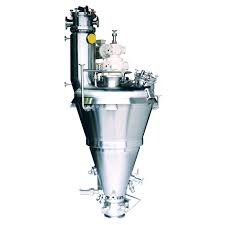
- Two cylindrical tanks with conical ends.
- One flat-bottomed cylindrical tank.
- One cylindrical settling tank with conical end.
- One diaphragm-type proportioning pump
- Two peristaltic pumps
- Two dc stirrers
- One magnetic stirrer
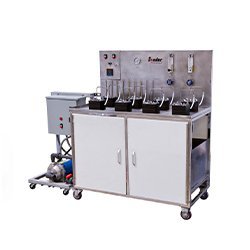
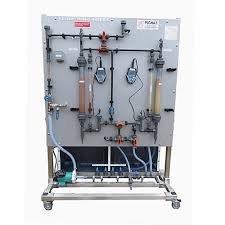
- One roller-mounted stainless steel chassis
Instrumentation :
- One redox potential controller (redox probe, converter, solid-state relay, peristaltic pump)
- One pH controller for tank 1 (pH probe, converter, self-matching controller, two solidstate relays, two peristaltic pumps).
- One pH controller for tank 2 (pH probe, converter, self-matching controller, one solidstate relay, one peristaltic pump).
- One pH meter (pH probe, converter, display unit).
- Two peristaltic pump controllers (variable speed drives with potentiometer control).
- Two stirrer speed controllers (frequency regulator and potentiometer)
Dimension and weight
Essential requirements
- 230 V / 50 Hz / single-phase power supply / 0.5 kW